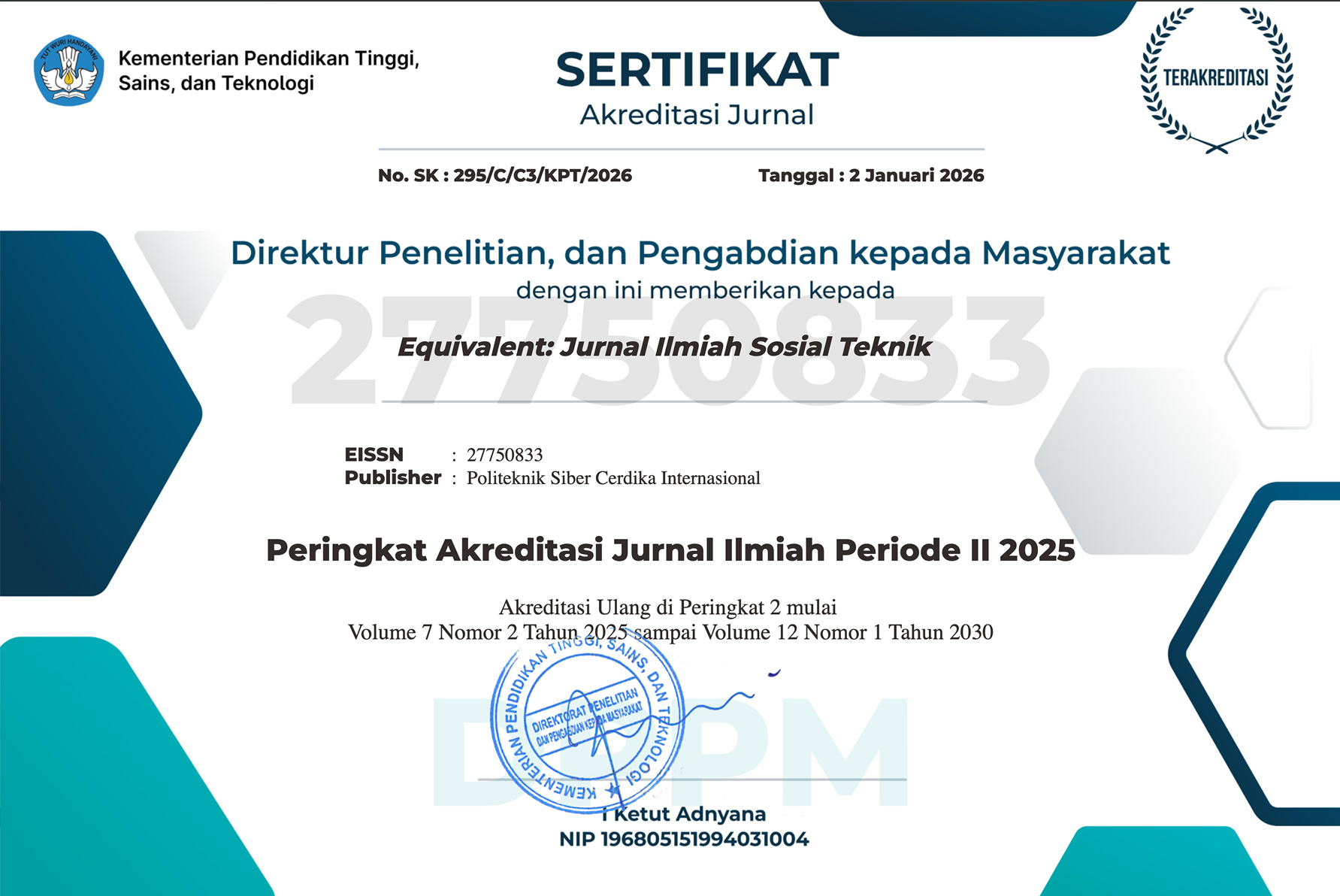
Cybersecurity And Social Resilience: A Technical Social Analysis On Data Protection Issues In The Era Of Globalization
DOI:
https://doi.org/10.59261/jequi.v6i2.239Keywords:
Cybersecurity;, Social Resilience;, Data Protection;, Public Perception;, Globalization;, Data BreachesAbstract
In the digital era, cybersecurity and data protection are crucial issues due to the increasing frequency and complexity of cyber threats. Personal data protection is now not only a technical issue, but also a social challenge that affects social resilience in the midst of globalization. This study aims to analyze the relationship between cybersecurity policy, public perception of data protection, and its impact on social resilience in various regions. A mixed-methods approach combining quantitative surveys and qualitative interviews was used to collect data from 500 respondents in Europe, Southeast Asia, North America, and Latin America. The results show that stronger cybersecurity frameworks, such as GDPR, are associated with high public trust and social resilience towards digital services. In addition, public perception and awareness of data protection policies have a significant impact on the effectiveness of these policies, with more informed communities showing higher levels of social resilience. The study also found that data breaches have a huge social impact, undermining trust and undermining community cohesion. However, an effective response to such breaches can restore public trust and strengthen social resilience. These findings suggest the importance of raising public awareness and strengthening cross-sector collaboration to strengthen social resilience to cyber threats.
Downloads
Downloads
Published
Issue
Section
License
Copyright (c) 2024 Mohamad Nasir, Antonio Guterres, Bonifácio de Deus

This work is licensed under a Creative Commons Attribution-ShareAlike 4.0 International License.
Authors who publish with this journal agree to the following terms:
- Authors retain copyright and grant the journal right of first publication with the work simultaneously licensed under a Creative Commons Attribution-ShareAlike 4.0 International (CC-BY-SA). that allows others to share the work with an acknowledgement of the work's authorship and initial publication in this journal.
- Authors are able to enter into separate, additional contractual arrangements for the non-exclusive distribution of the journal's published version of the work (e.g., post it to an institutional repository or publish it in a book), with an acknowledgement of its initial publication in this journal.
- Authors are permitted and encouraged to post their work online (e.g., in institutional repositories or on their website) prior to and during the submission process, as it can lead to productive exchanges, as well as earlier and greater citation of published work.